The joint action of the EU and NATO in Ukraine: are we doing enough?

In February 2022, Russia launched its full-scale invasion of Ukraine. This decision forced the European Union (EU) and the North Atlantic Treaty Organisation (NATO) to take more decisive action in supporting Ukraine’s defence of its territory. For example, many EU member states increased their defence spending and sent weaponry to Ukraine. However, the interoperability issue remains pertinent as the European Defence and Technological and Industrial Base (EDTIB) is structurally fragmented. Moreover, given Ukraine’s inheritance of Soviet-era weaponry, further training and logistical difficulties have arisen, posing setbacks and challenges to Ukraine’s effective defence strategies. This paper will discuss the joint action of the EU and NATO and its impact on Ukraine’s defence of its territory. The analysis will focus on the evolution of financial mechanisms and the creation of a military mission on the ground that complements nonmilitary efforts. Following this, it explores NATO’s complementary action, reinforcing cooperation with Ukraine and boosting armament in the East. Finally, the paper analyses hybrid threats in the examined case and problematises about a way forward through EU-NATO joint action.

Comments Off on The joint action of the EU and NATO in Ukraine: are we doing enough?

Artificial Intelligence and Autonomous Weapons – Strategic Ethical Considerations for European Defence

The integration of artificial intelligence (AI) into autonomous weapons systems represents a shift into modern warfare, offering unprecedented capabilities while posing profound stra- tegic and ethical challenges. This paper explores the strategic benefits and ethical challenges associated with deploying AI-driven technologies in European defence strategies. It highlights the potential military advantages, including enhanced operational efficiency, while addressing critical ethical concerns such as accountability, decision-making in life-or-death scenarios and the risk of conflict escalation. By analysing European defence policies and international frameworks, this study offers a nuanced perspective on balancing technological innovation with ethical imperatives, ensuring stability and adherence to international humanitarian law. Through case studies of European and global approaches, this paper’s aim is to inform strategies that harmonise security objectives with moral and legal principles.

Comments Off on Artificial Intelligence and Autonomous Weapons – Strategic Ethical Considerations for European Defence

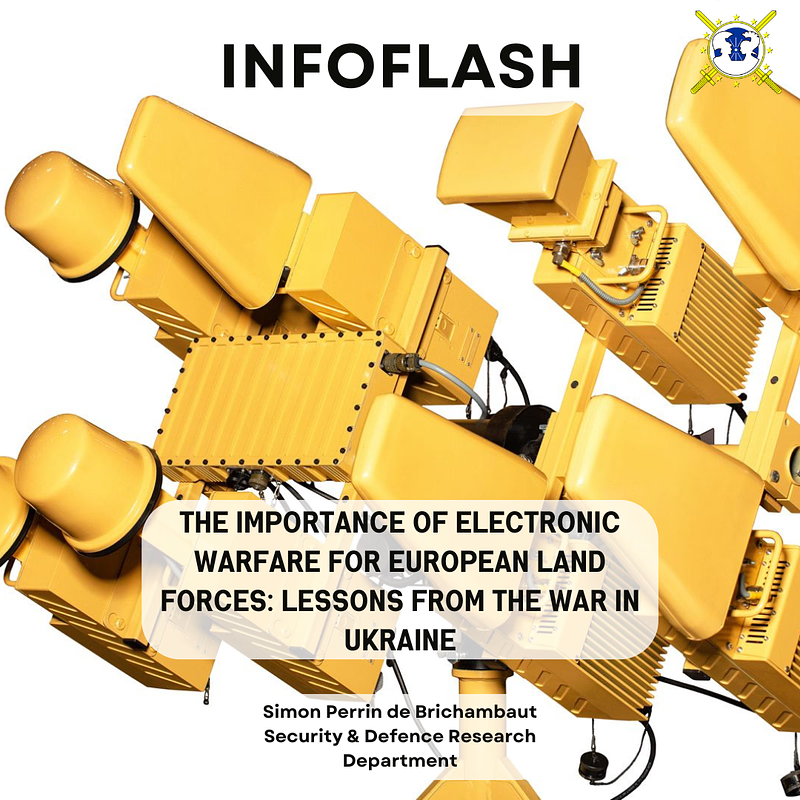
The Importance of Electronic Warfare for European Land Forces: Lessons from the War in Ukraine

Armed forces in all domains are becoming increasingly reliant on electronic equipment that uses the electromagnetic spectrum (EMS) and its associated frequencies. Electronic warfare (EW) serves both to secure and to deny access to the EMS. The war in Ukraine had demonstrated that EW capabilities are now crucial for land forces, with their scope and applications continuously expanding. For example, unmanned aerial vehicles (UAVs) have become the focus of a contest in EW between Ukraine and Russia, with each side attempting to deny the other the use of these systems and the EMS necessary for their operation. European land forces should observe and assimilate the lessons from Ukraine’s experience in EW, as their own EW capabilities have become largely obsolete or insufficient.

Comments Off on The Importance of Electronic Warfare for European Land Forces: Lessons from the War in Ukraine

Framework for the Future: Lessons Learned from the UK’s Approach to Integrated Battle Networks

This paper examines the evolution of the United Kingdom’s (UK) approach to integrated military network systems, analysing its strategies, technological advancements, and partnerships, particularly within the North Atlantic Treaty Organisation (NATO) and with European Union (EU) allies. The study underscores the UK’s commitment to Network-Centric Warfare (NCW) and multi-domain operations, outlining the development of foundational communication systems like Bowman and Network Enabled Capability (NEC), as well as newer projects, including Morpheus, TRINITY, and the Land Environment Tactical Communications and Information Systems (LETacCIS) program. The UK’s integration strategy prioritises secure, real-time data exchange across land, air, maritime, cyber, and space domains, aiming to enhance interoperability and strengthen resilience against hybrid threats. A key focus of this paper is on the UK’s collaboration with NATO and the EU in advancing secure communication frameworks, cyber resilience, and satellite capabilities through projects like Federated Mission Networking (FMN) and the SKYNET satellite system. As cyber and space domains become more critical, the UK’s evolving strategies demonstrate an adaptable, modular approach to maintaining technological superiority and coalition interoperability. To conclude, the paper highlights future directions for integrated networks, emphasising the importance of flexible, cyber-resilient, and quantum-encrypted systems to address emerging security challenges in a complex, multi-domain operational environment.

Comments Off on Framework for the Future: Lessons Learned from the UK’s Approach to Integrated Battle Networks

The Light Advantage: Exploring Li-Fi as the Next Frontier in Military Data Transmission

Light Fidelity (Li-Fi) is an emerging technology that revolutionises wireless communication by leveraging the visible light spectrum for data transmission. Addressing the limitations of tradi- tional radio frequency (RF)-based systems, Li-Fi offers unparalleled advantages in bandwidth, security, and energy efficiency. This paper examines Li-Fi’s transformative potential, partic- ularly in military contexts where secure and resilient communication is paramount. From enhancing command and control operations to facilitating naval coordination and disaster re- sponse, Li-Fi’s unique attributes, such as immunity to electromagnetic interference and high- speed transmission, make it a compelling alternative to RF technologies. However, issues like line-of-sight reliance and environmental sensitivity must be addressed be- fore widespread use occurs. The integration of Li-Fi with existing RF systems via hybrid tech- niques, as well as the new IEEE 802.11bb standardisation, point to a route towards practical feasibility. The paper also explores prospects, including Li-Fi’s role in multi-domain operations and its potential synergy with quantum encryption technologies. The study’s extensive research highlights Li-Fi’s importance in tackling current communica- tion difficulties, as well as its ability to reinvent connection in military and civilian applica- tions. The adoption of Li-Fi might signal a watershed moment in the transition to more secure, efficient, and adaptive wireless communication networks for an increasingly linked world by encouraging collaboration among governments, academics, and businesses.

Comments Off on The Light Advantage: Exploring Li-Fi as the Next Frontier in Military Data Transmission