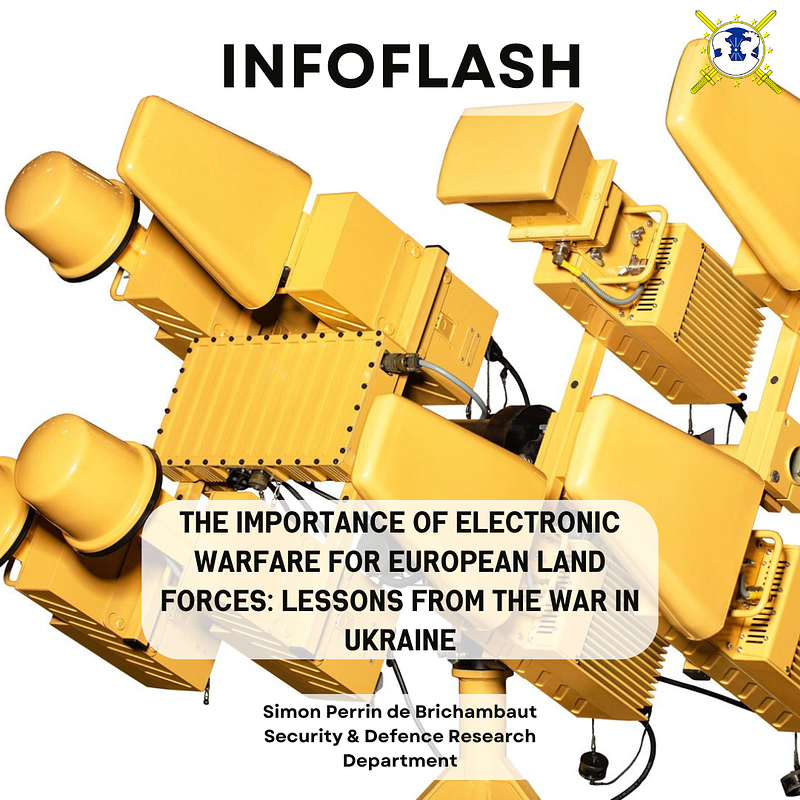
The Importance of Electronic Warfare for European Land Forces: Lessons from the War in Ukraine

Armed forces in all domains are becoming increasingly reliant on electronic equipment that uses the electromagnetic spectrum (EMS) and its associated frequencies. Electronic warfare (EW) serves both to secure and to deny access to the EMS. The war in Ukraine had demonstrated that EW capabilities are now crucial for land forces, with their scope and applications continuously expanding. For example, unmanned aerial vehicles (UAVs) have become the focus of a contest in EW between Ukraine and Russia, with each side attempting to deny the other the use of these systems and the EMS necessary for their operation. European land forces should observe and assimilate the lessons from Ukraine’s experience in EW, as their own EW capabilities have become largely obsolete or insufficient.

Comments Off on The Importance of Electronic Warfare for European Land Forces: Lessons from the War in Ukraine

A Legal Analysis of Space Debris I: The Kessler Syndrome and the Regulation of Space in International Law

The evolution of industrial models applied to space technologies has opened the door to space exploration and activities for smaller states and private actors. This proliferation of actors and the access to launching objects into Earth’s orbit has multiplied the amount of functional and non-functional objects in space, increasing the amount of space debris and the risk of triggering the Kessler Syndrome. This paper is the first of a series of articles analysing this challenge from a legal perspective. In this first part, the purpose is to frame the space debris threat and analyse the regulation of space in International Law.

Comments Off on A Legal Analysis of Space Debris I: The Kessler Syndrome and the Regulation of Space in International Law

The Crescent and The Star: A Turkish Option for the European Defence

This paper examines the evolving role of Türkiye’s military-industrial complex within the European security framework in light of shifting global power dynamics and the growing strategic autonomy debates within the European Union. As the United States retreats into isolationist policies, echoed by the Trump administration's stance on Ukraine, Europe increasingly seeks alternative and critical partnerships to bolster its defense capabilities. Türkiye, with its rapidly expanding indigenous defense industry and proven operational successes in previous conflicts such as Karabakh and Syria, emerges as a pivotal albeit complex partner for Europe. The study analyses Türkiye’s key defense platforms, including UAVs, naval assets like TCG Anadolu and PİRİREİS, and its collaboration with European companies such as Leonardo. It also evaluates the strategic opportunities and political risks involved in deepening military cooperation between Türkiye and the EU. The paper concludes by offering policy recommendations to balance pragmatic defense collaboration with broader geopolitical considerations.

Comments Off on The Crescent and The Star: A Turkish Option for the European Defence

The Role of the OSCE in European Conflict Prevention and Security

The Organisation for Security and Co-operation in Europe (OSCE) is the world’s largest regional security organisation, uniting 57 member states to promote peace, stability, and democracy. Through tools like the Vienna Document, election monitoring, and field missions, the OSCE fosters transparency, dialogue, and cooperation to prevent conflicts. Its comprehensive approach integrates military, economic, environmental, and human rights dimensions. While consensus-driven decisions ensure inclusivity, they can hinder swift action. Despite challenges, the OSCE remains vital in addressing evolving regional security risks.

Comments Off on The Role of the OSCE in European Conflict Prevention and Security

The legal approach of the nuclear deterrence policy: A resurgence of the concept with the European Security Defence

In an era characterised by resurgent geopolitical tensions, the role of nuclear deterrence is once again at the forefront of European defence strategy. Traditionally seen as a military safeguard, nuclear deterrence evolves into a complex legal construct, raising concerns about its legitimacy, constraints, and adaptability. As the Russian invasion has reignited debates over nuclear strategy, it becomes clear that the legal dimensions of deterrence reflect both a continuity of Cold War-era principles and a significant shift toward flexible, adaptive policies. 
Given the potentially disastrous effects on civilian populations, the current legal framework raises severe humanitarian questions, even though nuclear deterrence serves as a critical safeguard. Therefore, by exploring the legal basis of nuclear deterrence and its role within Europe’s defence architecture, this article highlights the need for scrutinised legal adaptability in a rapidly evolving security landscape. Maintaining credible deterrence while ensuring compliance with legal obligations and humanitarian principles remains essential to reduce civilian casualties. 

Comments Off on The legal approach of the nuclear deterrence policy: A resurgence of the concept with the European Security Defence